Free V5 literature sample collection | The Other Way In

The Other Way In · Free V5 sample collection

Read inside all five literature guides

Thirty selected pages from the current V5 editions, available to read online. See how each book helps learners investigate a text, use evidence and develop a written argument. No sign-in, payment or file download needed.

The passages are provided as accessible web text adapted from the 30-page V5 sample collection. Line breaks and spacing have been adjusted for screens. For original page design, see the watermarked examples on each product page.

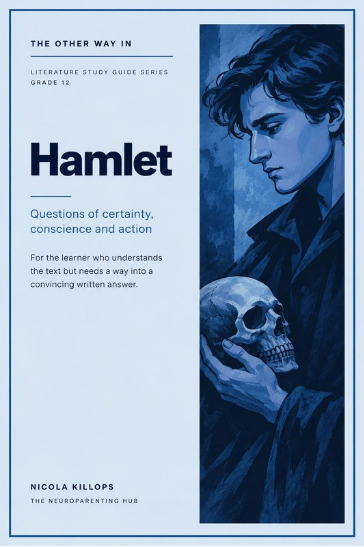
V5 cover of The Other Way In: Hamlet

Six sample pages

Hamlet

Read six selected pages from the current edition, including evidence and essay-building activities.

See the complete guide · R180 →
Sample 1 of 6 · From full guide page 1
T H E OT H E R WAY I N L I T E R AT U R E S T U DY G U I D E GRADE 12 Hamlet Questions of certainty, conscience and action For the learner who understands the text but needs a way into a convincing written answer. NICOLA KILLOPS THE NEUROPARENTING HUB FREE SAMPLE | V5 | Hamlet | from full guide p. 1
Sample 2 of 6 · From full guide page 4
YO U R F I R ST R E A D I N G M A P What counts as evidence when appearances are unreliable? Follow one line of argument through the text. Then return to the original scenes and test how convincing it is. 01 A ghost makes a claim 02 Hamlet investigates 03 Hesitation has consequences 04 Action changes the court An organising map is a starting point, not a substitute for the primary text. NICOLA KILLOPS · THE NEUROPARENTING HUB 04 FREE SAMPLE | V5 | Hamlet | from full guide p. 4
Sample 3 of 6 · From full guide page 8
T H E OT H E R WAY I N HAMLET From a thought to an argument A repeatable approach for this particular text A STARTING CHALLENGE Compare Hamlet’s words about hesitation with a decision he actually makes. Look for the cost of the difference. 01 NOTICE Underline the words in the question that ask for an argument. 02 LOCATE Find a scene, character choice or passage that gives you evidence. 03 INTERPRET Explain how this evidence supports a specific claim. 04 CHALLENGE Find something that complicates the claim or offers another reading. 05 COMPOSE Write a paragraph with a claim, precise evidence and analysis. 06 REVIEW Check quotation accuracy, logical connection and exam relevance. THREE QUESTIONS WORTH KEEPING • What can Hamlet know, and what is he willing to act upon? • How do public performance and private conscience collide? • Where does a scene complicate the easy explanation? Make your evidence trustworthy A practical check before you revise a quotation NICOLA KILLOPS · THE NEUROPARENTING HUB 08 FREE SAMPLE | V5 | Hamlet | from full guide p. 8
Sample 4 of 6 · From full guide page 13
PA R T 0 2 / H A M L E T Meet the world of Hamlet Find a specific moment. Consider competing interpretations. Build an argument that the text can support. 02 Before the Play Begins Denmark is uneasy. • A strong king has died — suddenly and offstage. • His brother now sits on the throne. • His widow has married that brother — with suspicious speed. • Their son, Prince Hamlet, is dressed in black, speaking in riddles, and refusing to play along. • The guards are seeing things. • A ghost is walking the castle walls, in armour, silent, and very familiar. Everyone is smiling at court. Everyone is lying. This is a play about silence, suspicion, spirals, and what happens when action takes too long to arrive. Before we follow Hamlet, let’s learn who’s in the room. 2.1 What’s Already Happened You don’t walk in on the first line of the story — things have already begun to go wrong. • The old King Hamlet (Hamlet’s father) is dead. • Claudius (his brother) has taken the throne. • Gertrude (the Queen, Hamlet’s mother) has married Claudius just weeks after the funeral. • Hamlet is grieving and suspicious. • A ghost has been seen on the castle walls. It looks like the old king. • The ghost won’t speak to anyone… yet. NICOLA KILLOPS · THE NEUROPARENTING HUB 13 FREE SAMPLE | V5 | Hamlet | from full guide p. 13
Sample 5 of 6 · From full guide page 78
T H E O T H E R W AY I N HAMLET Act 5, Scene 2: evidence and interpretation The important distinction is between a quotation, what happens in the scene and an interpretation that the quotation could support. Textual evidence Technique / moment Possible analysis “There’s a divinity that shapes our Language of providence and human Hamlet entertains the possibility that ends” (Hamlet). agency. some outcomes exceed human control; this does not erase his responsibility. Hamlet’s public apology to Laertes. Apology, explanation and self- The appeal to madness may seek presentation. reconciliation, but it also raises questions about accountability. “The King’s to blame” (Laertes). Disclosure as the plot collapses. The person who helped plan the duel exposes Claudius’s role. “Drink off this potion” (Hamlet). Retribution and dramatic irony. Claudius is made to face the means of death he prepared for another. “Good night, sweet prince” (Horatio). Farewell and memorial. The final witness becomes responsible for telling the story. Themes in motion Theme A developing interpretation Revenge and justice Hamlet acts, but the deaths resist a simple celebratory ending. Fate and agency Hamlet’s acceptance of uncertainty coexists with personal choices. Trust and testimony Laertes’s disclosure and Horatio’s survival give information a new public significance. Political succession Fortinbras’s arrival reframes a private tragedy as a national crisis. Check the precise wording and punctuation of all quoted lines against your prescribed text. NICOLA KILLOPS · THE NEUROPARENTING HUB 78 FREE SAMPLE | V5 | Hamlet | from full guide p. 78
Sample 6 of 6 · From full guide page 79
T H E O T H E R W AY I N HAMLET Act 5, Scene 2: symbols, choices and endings Symbols and dramatic functions Detail What happens An argument to test Poison The planned drink and the blade Claudius’s hidden intention ultimately become lethal. destroys his own household. Swords A public fencing contest becomes a Sport and political violence are murder attempt. uncomfortably close. The royal “union” The drink is offered as a celebration. A supposed gift conceals an act of betrayal. Horatio He survives to tell Hamlet’s story. A witness can resist the final triumph of concealment. Do not close the interpretation too early • Laertes confesses his part and names Claudius. Is this a complete moral redemption? • The ending contains both reconciliation and deaths. What remains unresolved? • Gertrude drinks despite Claudius’s warning. Distinguish what the scene shows from speculation about what she knows. • Claudius does speak after Hamlet wounds him, before Hamlet makes him drink the poison. His last words are a plea for assistance. Short writing task Imagine Horatio explaining the duel to Fortinbras. Write five key factual claims, then add a paragraph exploring one uncertainty he would still need to explain. Evidence rule: identify the act and scene before turning a summary into a quotation. NICOLA KILLOPS · THE NEUROPARENTING HUB 79 YOUR EVIDENCE NOTES FREE SAMPLE | V5 | Hamlet | from full guide p. 79
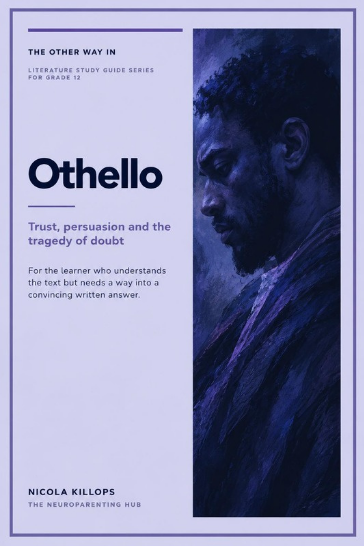
V5 cover of The Other Way In: Othello

Six sample pages

Othello

Read six selected pages from the current edition, including evidence and essay-building activities.

See the complete guide · R180 →
Sample 1 of 6 · From full guide page 1
T H E OT H E R WAY I N L I T E R AT U R E S T U DY G U I D E GRADE 12 Othello Trust, persuasion and the tragedy of doubt For the learner who understands the text but needs a way into a convincing written answer. NICOLA KILLOPS THE NEUROPARENTING HUB FREE SAMPLE | V5 | Othello | from full guide p. 1
Sample 2 of 6 · From full guide page 4
YO U R F I R ST R E A D I N G M A P How does a suggestion become an apparent certainty? Follow one line of argument through the text. Then return to the original scenes and test how convincing it is. 01 Plant suspicion 02 Control information 03 Misread evidence 04 Act on jealousy An organising map is a starting point, not a substitute for the primary text. NICOLA KILLOPS · THE NEUROPARENTING HUB 04 FREE SAMPLE | V5 | Othello | from full guide p. 4
Sample 3 of 6 · From full guide page 8
T H E OT H E R WAY I N OTHELLO From a thought to an argument A repeatable approach for this particular text A STARTING CHALLENGE Choose one claim Iago makes. Separate what a character knows from what the audience knows. 01 NOTICE Underline the words in the question that ask for an argument. 02 LOCATE Find a scene, character choice or passage that gives you evidence. 03 INTERPRET Explain how this evidence supports a specific claim. 04 CHALLENGE Find something that complicates the claim or offers another reading. 05 COMPOSE Write a paragraph with a claim, precise evidence and analysis. 06 REVIEW Check quotation accuracy, logical connection and exam relevance. THREE QUESTIONS WORTH KEEPING • What counts as evidence when Iago controls the story? • How do trust, race, reputation and gender change the stakes? • Whose voice is heard, and whose is dismissed? Make your evidence trustworthy A practical check before you revise a quotation NICOLA KILLOPS · THE NEUROPARENTING HUB 08 FREE SAMPLE | V5 | Othello | from full guide p. 8
Sample 4 of 6 · From full guide page 13
T H E O T H E R W AY I N OTHELLO Othello: an opening map The play begins with Iago’s grievances, racist language directed at Othello and hostility towards a marriage that Desdemona has chosen. The audience hears Iago’s plans before most of the people he manipulates do. Who gets to speak privately? Iago’s private speeches give the audience unusually direct access to his schemes. But Othello also speaks alone: his opening speech in Act 5, Scene 2 begins “It is the cause”. The contrast worth examining is the changing content of their private speech, not an absolute claim that the hero has no soliloquy. Essential orientation Element Reading cue Text Othello, the Moor of Venice, William Shakespeare; tragedy. Venice Public office, marriage, racial prejudice and social reputation. Cyprus Military duty, separation, vulnerability and the pressure of Iago’s manipulation. Iago Manipulates accounts of other people’s actions and later uses direct violence. Othello Moves from trust towards suspicion, makes choices and remains responsible for harming Desdemona. Desdemona Expresses her own decision to marry; later faces accusation, control and fatal violence. Five-act route Act Question worth asking 1 How do prejudice and allegations frame the marriage? 2 How does Cassio’s disgrace create an opening for Iago? 3 How are suggestions mistaken for proof? 4 How do jealousy, humiliation and coercion become visible? 5 Who reveals the truth, and what does accountability require? As you read, distinguish what the audience knows, what each character believes and what the text actually establishes. NICOLA KILLOPS · THE NEUROPARENTING HUB 13 FREE SAMPLE | V5 | Othello | from full guide p. 13
Sample 5 of 6 · From full guide page 91
T H E O T H E R W AY I N OTHELLO Essay workshop: from a claim to evidence The following are original practice prompts. They are not labelled as official past-paper questions. Use them to rehearse evidence-based interpretation. Build a paragraph Move Ask yourself Possible starting move Point What judgement answers the Shakespeare shows how Iago exploits question? Othello’s uncertainty. Evidence Which scene supports the judgement? Locate the exchange in Act 3, Scene 3. Explain What does the wording or action Separate Iago’s suggestion from reveal? Othello’s inference. Link What tension does this develop? Connect misinformation to Othello’s subsequent choices. Practice prompt 1: misplaced trust “Othello is a tragedy of misplaced trust.” How far does this account explain the catastrophe? Possible route: Begin with Othello and Desdemona’s account of their relationship in Act 1, Scene 3. Compare that with Iago’s insinuations in Act 3, Scene 3 and the violence of Act 5, Scene 2. Follow Check in the play Early How is their marriage defended publicly? Middle What does Iago imply without proving? Late Why does Othello act, and who bears the consequences? Challenge: Iago’s deception is important, but misplaced trust alone cannot explain or excuse Othello’s killing of Desdemona. NICOLA KILLOPS · THE NEUROPARENTING HUB 91 FREE SAMPLE | V5 | Othello | from full guide p. 91
Sample 6 of 6 · From full guide page 93
T H E O T H E R W AY I N OTHELLO Practice prompt 3: Desdemona’s agency and danger How does Shakespeare present Desdemona’s choices alongside the restrictions, coercion and violence she experiences? Desdemona speaks for her marriage before the Venetian court in Act 1, Scene 3. Her choices and commitments matter. Those choices do not make her responsible for Othello’s abuse or death at his hands. Scene Evidence to locate Important distinction Act 1, Scene 3 Desdemona speaks about her duty She asserts a choice in a public and the marriage. setting dominated by men. Act 4, Scene 2 Othello accuses her; she attempts to Her account of herself is disregarded. answer. Act 4, Scene 3 Conversation with Emilia. Different experiences and expectations of marriage are expressed. Act 5, Scene 2 Desdemona is murdered; her last Her words do not excuse or remove responses are open to careful Othello’s responsibility. interpretation. Avoid these conclusions • That agency prevents someone from also being a victim of violence. • That silence necessarily indicates agreement. • That Desdemona’s final words are a moral gift which cancels the killing. Write two sentences about Desdemona’s independence and two about the pressure placed on her. Explain how Shakespeare makes both visible. NICOLA KILLOPS · THE NEUROPARENTING HUB 93 YOUR EVIDENCE NOTES FREE SAMPLE | V5 | Othello | from full guide p. 93

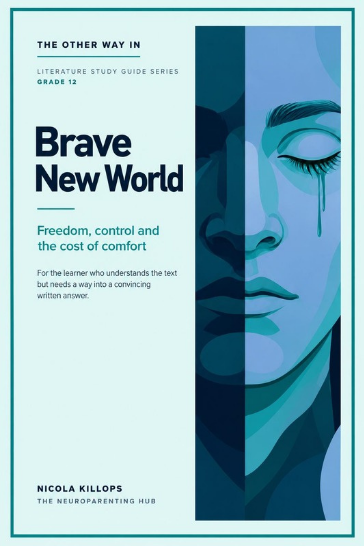
V5 cover of The Other Way In: Brave New World

Six sample pages

Brave New World

Read six selected pages from the current edition, including evidence and essay-building activities.

See the complete guide · R180 →
Sample 1 of 6 · From full guide page 1
T H E OT H E R WAY I N L I T E R AT U R E S T U DY G U I D E GRADE 12 Brave New World Freedom, control and the cost of comfort For the learner who understands the text but needs a way into a convincing written answer. NICOLA KILLOPS THE NEUROPARENTING HUB FREE SAMPLE | V5 | Brave New World | from full guide p. 1
Sample 2 of 6 · From full guide page 4
YO U R F I R ST R E A D I N G M A P How does the World State secure compliance? Follow one line of argument through the text. Then return to the original scenes and test how convincing it is. 01 Plan reproduction 02 Condition citizens 03 Manage discomfort 04 Reinforce conformity An organising map is a starting point, not a substitute for the primary text. NICOLA KILLOPS · THE NEUROPARENTING HUB 04 FREE SAMPLE | V5 | Brave New World | from full guide p. 4
Sample 3 of 6 · From full guide page 13
A D I F F E R E N T WAY I N / B R AV E N E W W O R L D The stability machine The World State’s systems reinforce one another. PRODUCTION Caste and reproduction are centrally organised. CONDITIONING Repeated messages teach approved desires. COMPLIANCE Consumption and soma help manage dissatisfaction. RETURN TO THE TEXT What becomes difficult to choose when many preferences have been organised in advance? Find the passage behind each observation before you use it in an essay. These descriptions are paraphrases, not quotations. NICOLA KILLOPS · THE NEUROPARENTING HUB 13 FREE SAMPLE | V5 | Brave New World | from full guide p. 13
Sample 4 of 6 · From full guide page 28
T H E OT H E R WAY I N BRAVE NEW WORLD Freedom under managed happiness A claim you can test The World State treats stability as the highest collective good and limits choices that could introduce uncertainty. This is a political decision, rather than an inevitable property of happiness. Scene evidence The caste and conditioning procedures at the Hatchery. The social pressure Bernard experiences when he behaves differently. The confrontation between John and Mond in chapters 16–17. An important complication John’s objections expose genuine losses, but his behaviour is not always admirable. Mond can identify the costs of freedom without persuading the reader that state control is justified. Essay route Argue what the World State offers, name what it restricts, then explain why a character cannot accept the bargain. QUOTE DISCIPLINE If a summary says “Mond values stability over truth”, write it as your interpretation, without quotation marks. Soma, grief and the politics of feeling In the novel The World State makes soma available to manage unwanted feeling and preserve conformity. Its effect belongs to Huxley’s fictional political and cultural system. Two revealing events Linda’s long dependence on soma and John’s response to her dying. John’s attempt to interrupt soma distribution and the resulting disturbance. Avoid false medical comparisons The text can support an argument about a state controlling emotion. It cannot support the claim that ordinary prescribed medication is equivalent to soma, or that any treatment for distress is morally suspect. Build the paragraph NICOLA KILLOPS · THE NEUROPARENTING HUB 28 FREE SAMPLE | V5 | Brave New World | from full guide p. 28
Sample 5 of 6 · From full guide page 43
T H E O T H E R W AY I N B R AV E N E W W O R L D Thinking tools: choose a route into the text Bloom’s revised taxonomy and de Bono’s thinking tools can give you useful questions. Neither is a fixed sequence that every learner must follow, and no study method guarantees higher marks. Bloom: six useful kinds of question Thinking action Book-specific example Remember Identify two features of conditioning in the World State. Understand Explain why soma supports social stability. Apply Use the idea of conditioning to interpret a character’s decision. Analyse Compare John’s and Mond’s views of freedom. Evaluate Assess the cost of the World State’s stability. Create Compose a short argument from an unfamiliar character’s perspective, then test it against the novel. Using the Six Thinking Hats The hats are deliberate questions to try, not labels for different kinds of brains. Choose one scene. Ask first what the text establishes, then how a character may feel, then which risks, benefits and alternative explanations are visible. Evidence check: record a chapter reference for each claim before drafting an essay. NICOLA KILLOPS · THE NEUROPARENTING HUB 43 YOUR EVIDENCE NOTES FREE SAMPLE | V5 | Brave New World | from full guide p. 43
Sample 6 of 6 · From full guide page 44
T H E O T H E R W AY I N B R AV E N E W W O R L D Six Thinking Hats and CoRT: working tables A Six Hats comparison Hat Question function Brave New World example White What facts are available? What do the conditioning scenes actually show? Red What emotional response is visible? How might Lenina experience conflict with John? Black What risks or limitations are present? What dangers accompany managed happiness? Yellow What is the possible advantage? Why might citizens value stability? Green What other possibility could be What alternative response could tested? Helmholtz imagine? Blue How will I organise the inquiry? Which two scenes best support my argument? CoRT: three starting prompts Tool Meaning Question CAF Consider All Factors Which competing needs does Mond consider, and which does he exclude? OPV Other People’s Views How might Lenina and John interpret the same event differently? PMI Plus, Minus, Interesting What are the attractions, costs and uncertainties of removing discomfort? Other CoRT tools include AGO (Aims, Goals, Objectives) and FIP (First Important Priorities). These help sort questions; they do not supply answers. Choose any one row. Give an initial response, then locate evidence that might challenge it. NICOLA KILLOPS · THE NEUROPARENTING HUB 44 FREE SAMPLE | V5 | Brave New World | from full guide p. 44
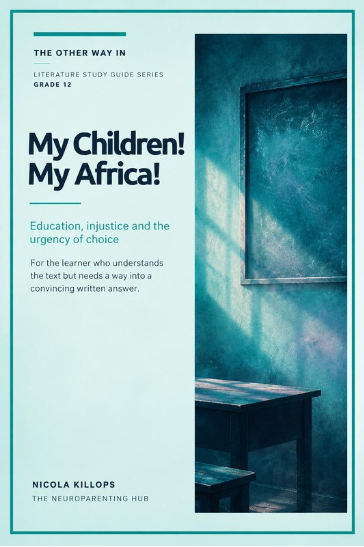
V5 cover of The Other Way In: My Children! My Africa!

Six sample pages

My Children! My Africa!

Read six selected pages from the current edition, including evidence and essay-building activities.

See the complete guide · R180 →
Sample 1 of 6 · From full guide page 1
T H E OT H E R WAY I N L I T E R AT U R E S T U DY G U I D E GRADE 12 My Children! My Africa! Education, injustice and the urgency of choice For the learner who understands the text but needs a way into a convincing written answer. NICOLA KILLOPS THE NEUROPARENTING HUB FREE SAMPLE | V5 | My Children My Africa | from full guide p. 1
Sample 2 of 6 · From full guide page 4
YO U R F I R ST R E A D I N G M A P How do conviction and urgency change the meaning of education? Follow one line of argument through the text. Then return to the original scenes and test how convincing it is. 01 Begin in debate 02 Examine social pressures 03 Confront divided strategies 04 Evaluate the cost An organising map is a starting point, not a substitute for the primary text. NICOLA KILLOPS · THE NEUROPARENTING HUB 04 FREE SAMPLE | V5 | My Children My Africa | from full guide p. 4
Sample 3 of 6 · From full guide page 13
A D I F F E R E N T WAY I N / M Y C H I L D R E N ! M Y A F R I C A ! Three places in one debate The same events carry different pressures for the main characters. MR M Sees education as a route to agency and long-term change. THAMI Confronts the urgency and collective demands of resistance. ISABEL Learns to question assumptions through encounter and debate. RETURN TO THE TEXT What can each character recognise, and what might each still fail to see? Find the passage behind each observation before you use it in an essay. These descriptions are paraphrases, not quotations. NICOLA KILLOPS · THE NEUROPARENTING HUB 13 FREE SAMPLE | V5 | My Children My Africa | from full guide p. 13
Sample 4 of 6 · From full guide page 29
T H E OT H E R WAY I N MY CHILDREN! MY AFRICA! VERIFIED SHORT EXTRACT | MR M “Don’t scorn words. They are sacred!” Mr M is defending the power of language to influence minds. His statement is passionate, even desperate, because he fears that Thami will abandon the education to which he has devoted his life. How to use this evidence The dictionary: knowledge, accumulated voices and possibilities for political argument. The stone: urgency, protest and direct confrontation with state violence. The collision: two responses to oppression, neither reducible to foolishness. ? What should an essay question next? Does Mr M underestimate the constraints imposed by apartheid? Does Thami dismiss the possibilities of language too quickly? Use the confrontation to test both positions rather than choosing a hero. Text location: Act 2, scene 3. Line and page numbers vary by edition. Thami is arguing about consequences Act 2, scene 3 | A response to Mr M’s faith in education Paraphrase accurately Thami argues that classroom exercises and impressive English vocabulary have not secured freedom. His frustration is directed at the apparent gap between what education promises and what the political situation permits. SCENE ANCHOR | THAMI AND MR M Return to the argument about what the struggle needs and the value of the language Mr M has taught. Do not turn your summary into an invented direct quotation. The intellectual tension Mr M treats language as a tool that can reach people across divisions. Thami doubts that the same institutions can deliver justice quickly enough. Both understand the stakes. Their disagreement concerns political strategy and the time available to act. A worked analytical claim NICOLA KILLOPS · THE NEUROPARENTING HUB 29 FREE SAMPLE | V5 | My Children My Africa | from full guide p. 29
Sample 5 of 6 · From full guide page 36
T H E O T H E R W AY I N MY CHILDREN! MY AFRICA! Essay planning: question, pressure and evidence A strong essay explains what the question asks, identifies a tension within the play and supports an interpretation with specific moments. The historical injustice of apartheid is the context, not a matter for neutral debate. Decode the question If the question centres on… You might investigate… Education Mr M’s belief in language and learning, and its limits under structural injustice. Youth and political action The urgency experienced by Thami and the pressures on learners. Language When words enable understanding and when they fail to protect people. Relationships How power and experience affect communication between characters. Tragedy How decisions, conflict and unequal conditions shape the ending. Develop a qualified thesis Too broad More useful “Education is important.” “Fugard presents education as a source of dignity whose power is restricted by the urgency of political injustice.” “Thami is right and Mr M is wrong.” “The play reveals the pressures behind both positions while insisting that the oppression confronting them is real.” Track change over time Consider debate, emerging disagreement, political pressure, confrontation and aftermath. Use the actual play to check this suggested progression. Plan a paragraph around belief → evidence → pressure → consequence. Then ask what your interpretation leaves out. NICOLA KILLOPS · THE NEUROPARENTING HUB 36 FREE SAMPLE | V5 | My Children My Africa | from full guide p. 36
Sample 6 of 6 · From full guide page 41
T H E O T H E R W AY I N MY CHILDREN! MY AFRICA! Practice questions: four analytical routes The following are original study prompts, not official examination questions. Each asks you to build a position that can be tested against Fugard’s text. Study prompt What to investigate 1. How does Fugard present the purpose of education? Mr M’s teaching philosophy, Thami’s disagreement and the context of apartheid. 2. To what extent is Thami justified in rejecting Mr M’s The urgency of political injustice, power in the classroom approach? and possible costs of each course. 3. How does the play connect time with the demand for Who can afford to wait, and how are the options unequal? change? 4. How does the ending alter the audience’s understanding Return to the dialogue and examine the tragic of the earlier debate? consequences carefully. Choose an argument before writing Summarise the question in your own words. Select two specific dramatic exchanges or events that could support a response. Then identify one that might complicate it. Plan with evidence Paragraph What will you explain? Evidence location Opening position State the judgement your essay will Name the relevant moment. explore. Development Explain a belief under pressure. Name the dialogue or action. Complication Offer a relevant competing reading. Identify another passage. Conclusion Answer the question in light of your No new untested quotation. analysis. You may reach a clear conclusion. Complexity does not require treating every position as equally defensible. NICOLA KILLOPS · THE NEUROPARENTING HUB 41 FREE SAMPLE | V5 | My Children My Africa | from full guide p. 41
V5 cover of The Other Way In: The Picture of Dorian Gray

Six sample pages

The Picture of Dorian Gray

Read six selected pages from the current edition, including evidence and essay-building activities.

See the complete guide · R180 →
Sample 1 of 6 · From full guide page 1
T H E OT H E R WAY I N L I T E R AT U R E S T U DY G U I D E GRADE 12 The Picture of Dorian Gray Beauty, influence and moral consequence For the learner who understands the text but needs a way into a convincing written answer. NICOLA KILLOPS THE NEUROPARENTING HUB FREE SAMPLE | V5 | The Picture of Dorian Gray | from full guide p. 1
Sample 2 of 6 · From full guide page 4
YO U R F I R ST R E A D I N G M A P Can Dorian separate his public image from the consequences of his choices? Follow one line of argument through the text. Then return to the original scenes and test how convincing it is. 01 Encounter influence 02 Choose and conceal 03 Portrait records change 04 Face consequence An organising map is a starting point, not a substitute for the primary text. NICOLA KILLOPS · THE NEUROPARENTING HUB 04 FREE SAMPLE | V5 | The Picture of Dorian Gray | from full guide p. 4
Sample 3 of 6 · From full guide page 5
T H E OT H E R WAY I N THE PICTURE OF DORIAN GRAY V I S UA L R E A D I N G AT L AS THE PORTRAIT AS EVIDENCE Appearance, action and consequence ? What can the portrait reveal that society cannot see? MOVE THROUGH THE TEXT 01 INFLUENCE Dorian encounters Henry’s worldview. EARLY CHAPTERS 02 CHOICE His treatment of Sibyl has consequences. CHAPTERS 7–8 03 CONCEAL The portrait records what is hidden. MIDDLE CHAPTERS 04 FINAL ACT Destroying the image does not erase the life. FINAL CHAPTER USE THIS MAP AS A QUESTION, THEN RETURN TO THE PRIMARY TEXT. V I S UA L R E A D I N G AT L AS INFLUENCE IS NOT DESTINY A moral argument needs careful distinctions ? How much responsibility belongs to Dorian? NICOLA KILLOPS · THE NEUROPARENTING HUB 05 FREE SAMPLE | V5 | The Picture of Dorian Gray | from full guide p. 5
Sample 4 of 6 · From full guide page 25
A D I F F E R E N T WAY I N / T H E P I C T U R E O F D O R I A N G R AY Two versions of Dorian The novel sets public appearance against concealed consequences. PUBLIC IMAGE Dorian continues to appear young. PRIVATE RECORD The portrait changes as his actions accumulate. RESPONSIBILITY Concealment does not release him from the consequences. RETURN TO THE TEXT How does the portrait change what readers know that other characters cannot see? Find the passage behind each observation before you use it in an essay. These descriptions are paraphrases, not quotations. NICOLA KILLOPS · THE NEUROPARENTING HUB 25 FREE SAMPLE | V5 | The Picture of Dorian Gray | from full guide p. 25
Sample 5 of 6 · From full guide page 58
T H E OT H E R WAY I N THE PICTURE OF DORIAN GRAY Your brain can take information in through multiple routes: Choose an approach that suits the task, not a fixed learner type Approach Examples Useful for Visual Diagrams, colour and layout Patterns and contrast Auditory Music, discussion and reading aloud Rhythm and sequencing Verbal Explanation and writing Argument and clarity Movement and Movement, building and gesture Memory and grounding gesture Emotional Connection and relevance Motivation Strong learning uses more than one channel at a time. Colour Coding as Thinking (Not Decoration) Colour is not for pretty notes. It is for categorising thought. A Core Colour System (suggested) Suggested reading cues: use the labels as well as any colours Reading cue Interpretive purpose Thinking tool Red Danger or harm Black Hat Yellow Possible benefit or attraction Yellow Hat Blue Organisation or control Blue Hat Green Alternatives Green Hat Grey Facts or events White Hat Example: When studying Dorian Gray, colour ideas by function, not chapter. This lets visual thinkers see moral structure. Music and Sound as Cognitive Anchors NICOLA KILLOPS · THE NEUROPARENTING HUB 58 FREE SAMPLE | V5 | The Picture of Dorian Gray | from full guide p. 58
Sample 6 of 6 · From full guide page 62
PA R T 0 9 / T H E P I C T U R E O F D O R I A N G R AY Thinking with AI support Find a specific moment. Consider competing interpretations. Build an argument that the text can support. 09 Stage Strategy Shaping step-by-step plans Expression structured logic Review rule-based checks If stuck: Make expectations explicit. Combining Intelligences (The Real Skill) Most learners need blended routes. Example: • Visual processing • Verbal shaping • Logical expression PART 9: THINKING WITH SUPPORT — USING AI THE RIGHT WAY This final part sits beneath technique and beyond exams. By now, you understand the novel. You know how to plan, analyse, and write. This section asks something quieter and more difficult: ? How do you think responsibly — with help — without giving your thinking away? NICOLA KILLOPS · THE NEUROPARENTING HUB 62 FREE SAMPLE | V5 | The Picture of Dorian Gray | from full guide p. 62