Sample 1 of 6 · From full guide page 1
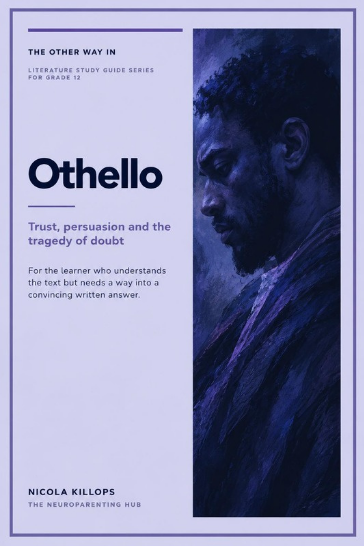
T H E OT H E R WAY I N
L I T E R AT U R E S T U DY G U I D E
GRADE 12
Othello
Trust, persuasion and the tragedy of doubt
For the learner who understands the text but
needs a way into a convincing written answer.
NICOLA KILLOPS
THE NEUROPARENTING HUB
FREE SAMPLE | V5 | Othello | from full guide p. 1
Sample 2 of 6 · From full guide page 4
YO U R F I R ST R E A D I N G M A P
How does a suggestion become an
apparent certainty?
Follow one line of argument through the text. Then return to the original scenes and test
how convincing it is.
01 Plant suspicion
02 Control information
03 Misread evidence
04 Act on jealousy
An organising map is a starting point, not a substitute for the primary text.
NICOLA KILLOPS · THE NEUROPARENTING HUB 04
FREE SAMPLE | V5 | Othello | from full guide p. 4
Sample 3 of 6 · From full guide page 8
T H E OT H E R WAY I N OTHELLO
From a thought to an argument
A repeatable approach for this particular text
A STARTING CHALLENGE
Choose one claim Iago makes. Separate what a character knows from what the audience
knows.
01 NOTICE
Underline the words in the question that ask for an argument.
02 LOCATE
Find a scene, character choice or passage that gives you evidence.
03 INTERPRET
Explain how this evidence supports a specific claim.
04 CHALLENGE
Find something that complicates the claim or offers another reading.
05 COMPOSE
Write a paragraph with a claim, precise evidence and analysis.
06 REVIEW
Check quotation accuracy, logical connection and exam relevance.
THREE QUESTIONS WORTH KEEPING
• What counts as evidence when Iago controls the story?
• How do trust, race, reputation and gender change the stakes?
• Whose voice is heard, and whose is dismissed?
Make your evidence trustworthy
A practical check before you revise a quotation
NICOLA KILLOPS · THE NEUROPARENTING HUB 08
FREE SAMPLE | V5 | Othello | from full guide p. 8
Sample 4 of 6 · From full guide page 13
T H E O T H E R W AY I N OTHELLO
Othello: an opening map
The play begins with Iago’s grievances, racist language directed at Othello and hostility towards a marriage that
Desdemona has chosen. The audience hears Iago’s plans before most of the people he manipulates do.
Who gets to speak privately?
Iago’s private speeches give the audience unusually direct access to his schemes. But Othello also speaks alone: his
opening speech in Act 5, Scene 2 begins “It is the cause”. The contrast worth examining is the changing content of
their private speech, not an absolute claim that the hero has no soliloquy.
Essential orientation
Element Reading cue
Text Othello, the Moor of Venice, William Shakespeare; tragedy.
Venice Public office, marriage, racial prejudice and social
reputation.
Cyprus Military duty, separation, vulnerability and the pressure of
Iago’s manipulation.
Iago Manipulates accounts of other people’s actions and later
uses direct violence.
Othello Moves from trust towards suspicion, makes choices and
remains responsible for harming Desdemona.
Desdemona Expresses her own decision to marry; later faces
accusation, control and fatal violence.
Five-act route
Act Question worth asking
1 How do prejudice and allegations frame the marriage?
2 How does Cassio’s disgrace create an opening for Iago?
3 How are suggestions mistaken for proof?
4 How do jealousy, humiliation and coercion become visible?
5 Who reveals the truth, and what does accountability
require?
As you read, distinguish what the audience knows, what each character believes and what the text
actually establishes.
NICOLA KILLOPS · THE NEUROPARENTING HUB 13
FREE SAMPLE | V5 | Othello | from full guide p. 13
Sample 5 of 6 · From full guide page 91
T H E O T H E R W AY I N OTHELLO
Essay workshop: from a claim to evidence
The following are original practice prompts. They are not labelled as official past-paper questions. Use them to
rehearse evidence-based interpretation.
Build a paragraph
Move Ask yourself Possible starting move
Point What judgement answers the Shakespeare shows how Iago exploits
question? Othello’s uncertainty.
Evidence Which scene supports the judgement? Locate the exchange in Act 3, Scene
3.
Explain What does the wording or action Separate Iago’s suggestion from
reveal? Othello’s inference.
Link What tension does this develop? Connect misinformation to Othello’s
subsequent choices.
Practice prompt 1: misplaced trust
“Othello is a tragedy of misplaced trust.” How far does this account explain the catastrophe?
Possible route: Begin with Othello and Desdemona’s account of their relationship in Act 1, Scene 3. Compare that
with Iago’s insinuations in Act 3, Scene 3 and the violence of Act 5, Scene 2.
Follow Check in the play
Early How is their marriage defended publicly?
Middle What does Iago imply without proving?
Late Why does Othello act, and who bears the consequences?
Challenge: Iago’s deception is important, but misplaced trust alone cannot explain or excuse Othello’s killing of
Desdemona.
NICOLA KILLOPS · THE NEUROPARENTING HUB 91
FREE SAMPLE | V5 | Othello | from full guide p. 91
Sample 6 of 6 · From full guide page 93
T H E O T H E R W AY I N OTHELLO
Practice prompt 3: Desdemona’s agency and danger
How does Shakespeare present Desdemona’s choices alongside the restrictions, coercion and violence
she experiences?
Desdemona speaks for her marriage before the Venetian court in Act 1, Scene 3. Her choices and commitments
matter. Those choices do not make her responsible for Othello’s abuse or death at his hands.
Scene Evidence to locate Important distinction
Act 1, Scene 3 Desdemona speaks about her duty She asserts a choice in a public
and the marriage. setting dominated by men.
Act 4, Scene 2 Othello accuses her; she attempts to Her account of herself is disregarded.
answer.
Act 4, Scene 3 Conversation with Emilia. Different experiences and
expectations of marriage are
expressed.
Act 5, Scene 2 Desdemona is murdered; her last Her words do not excuse or remove
responses are open to careful Othello’s responsibility.
interpretation.
Avoid these conclusions
• That agency prevents someone from also being a victim of violence.
• That silence necessarily indicates agreement.
• That Desdemona’s final words are a moral gift which cancels the killing.
Write two sentences about Desdemona’s independence and two about the pressure placed on her.
Explain how Shakespeare makes both visible.
NICOLA KILLOPS · THE NEUROPARENTING HUB 93
YOUR EVIDENCE NOTES
FREE SAMPLE | V5 | Othello | from full guide p. 93